Sinopsis
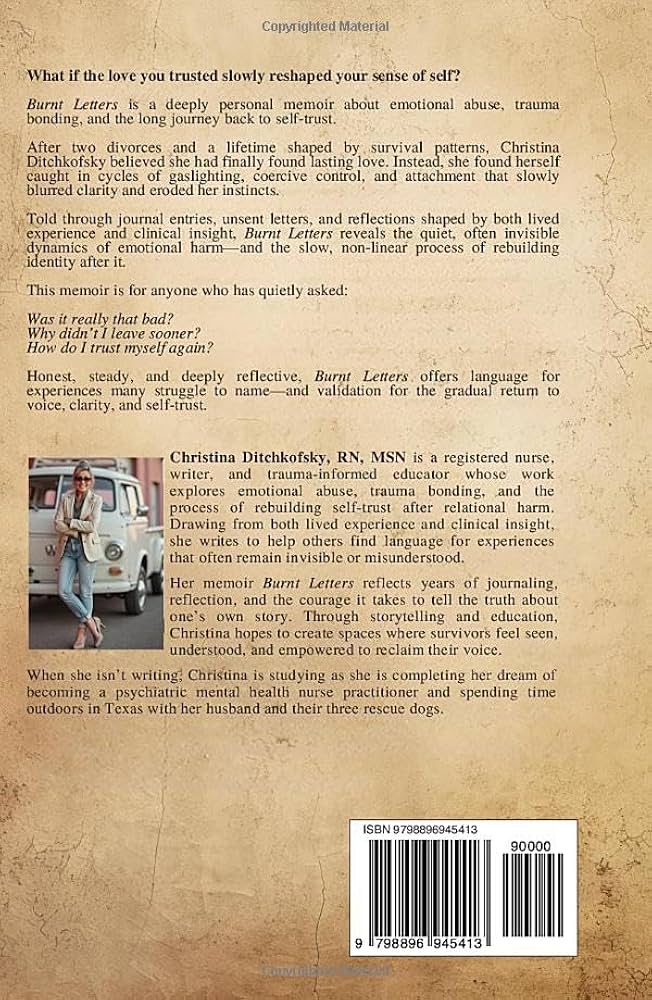
Christina Ditchkofsky’s Burnt Letters operates as an exceptionally raw, validating catalyst for trauma-informed narrative bibliotherapy, delivering a striking look at the quiet, invisible realities of emotional and spiritual abuse. Bypassing superficial, clinical checklists, the memoir uses a layout of fragments, journal entries, and therapy reflections to serve as an authentic psychological mirror for readers struggling to voice their own domestic nightmares. The therapeutic power of this text lies in its refusal to offer quick, manufactured inspiration. Instead, it serves as a comforting witness that honors the non-linear chaos of surviving a trauma bond, giving the reader a safe space to process lingering shame, father wounds, and confusion. For any survivor, clinician, or individual trapped in the depths of emotional despair, this book changes the isolating weight of trauma into a shared path toward clarity, boundary development, and complete self-reclamation.
| Nombor Buku | 362.829 |
|---|
| Tempat Terbitan | US |
|---|
| Penerbit | selfpublishing.com |
|---|
| Ukuran Tinggi Buku | 9798896944010 |
|---|
Sasaran Biblioterapi
| Bil |
Sasaran |
Bukti Isi Buku |
| 1 |
Survivors of intimate partner violence, narcissistic manipulation, gaslighting, and domestic or spiritual abuse. |
Author Christina Ditchkofsky frames her story using raw, unstructured fragments, diary flashbacks, and "battlefield poetry" that speak directly to individuals stuck in a trauma bond or struggling to make sense of why leaving a toxic relationship feels so physically and mentally paralyzing. |
| 2 |
Mental health counselors, trauma-informed therapists, and loved ones of abuse victims seeking to understand the psychology of coercive control. |
The narrative details the invisible mechanics of covert emotional abuse that happen in plain sight, deliberately including the intense "clouded mind" state and deep self-doubt that victims experience. This provides professionals with a clear case study to look past outside judgments and decode how individuals become dependency-tethered to their abusers. |
Perkembangan Diri
| Bil |
Perkembangan |
Bukti Isi Buku |
| 1 |
Reframing Self-Doubt as an Adaptive Survival Strategy |
Ditchkofsky shifts the reader's view of trauma responses, demonstrating that constantly questioning one's own memory and perception was not an act of personal weakness. Instead, the text illustrates that hypervigilance was a necessary, brilliant way the mind adapted to keep the individual safe within a chaotic environment, fostering deep emotional self-compassion. |
| 2 |
Reclaiming Cognitive Reality and Instinctual Trust |
The memoir details the slow process of breaking a trauma bond through rigorous therapy and self-examination. By chronicling her realization that "she was never the one who needed fixing," the author provides the reader with a concrete blueprint for building cognitive clarity and self-trust after years of psychological gaslighting. |
| 3 |
Narrative Catharsis via Expressive Writing and Letting Go |
The text highlights the active therapeutic practice of writing down hidden feelings and physically burning unsent letters originally meant to fix the abuser. This somatic act models deep self-development by showing the reader how to externalize buried emotional blockages, process intergenerational wounds, and claim absolute future autonomy. |